
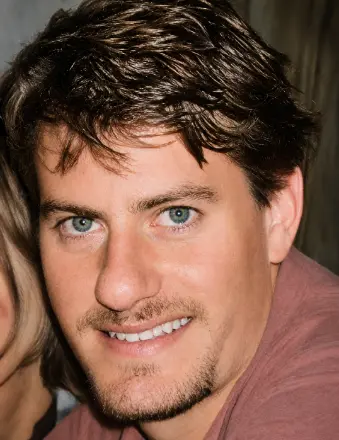
Patrick Fitzgerald, who wrote for Ex-Gay Watch from 2009 to 2013, died May 11, 2026, in Naples, Florida. He was 57.
Patrick’s obituary describes a man whose interests ranged well beyond the subjects he covered here. He was a gardener, philosopher and inventor who worked primarily in hospitality. Friends and family remembered his creativity, curiosity, gentle and sensitive nature, and unusual way of looking at the world.
That curiosity was evident in his writing for Ex-Gay Watch. Patrick wrote about Exodus International, PFOX, conversion therapy, the religious right, marriage equality, anti-gay bullying and figures including Alan Chambers, Randy Thomas, Christopher Doyle, Arthur Goldberg, Michael Brown and Nancy Heche.
But reading his articles together, those subjects begin to look like parts of a larger question: Patrick was interested in what happened when prejudice was repackaged as compassion.
When “compassion” required gay people to change
Ex-gay ministries routinely presented themselves not as opponents of gay people but as people who loved them enough to offer an alternative to homosexuality.
Patrick kept looking underneath that language.
In one of his earliest articles, “Exodus Youth Condemns Bullying by Singling Out Gay Students”, he examined an Exodus Youth article offering a supposedly compassionate Christian response to the bullying of gay students.
Patrick saw a contradiction. The ministry acknowledged the suffering caused by anti-gay bullying but then singled out gay students themselves for religious intervention. It spoke of “unconditional love” while treating same-sex attraction as brokenness, perhaps more broken than the bullying.
Patrick asked, in effect, why the victims needed to be changed instead of the bullies. He objected to the assumption that homosexuality was a “fault” that compassionate Christians should overlook: “Seeing a non-existent fault,” he concluded, “is a fault.”
That tension recurred throughout his work. Patrick was less interested in whether an organization called itself compassionate than in what its beliefs required it to say and do to actual LGBT people.
Listening to what ex-gay activists actually said
Patrick had a particular interest in primary sources. He read books and organizational statements, transcribed broadcasts and videos, and examined what activists actually said rather than relying on summaries of their positions.
In his review of Alan Chambers’ Leaving Homosexuality, Patrick noticed that Chambers rejected the conservative claim that people simply choose to be homosexual while continuing to promote “leaving homosexuality.”
He challenged Exodus vice president Randy Thomas when Thomas dismissed anti-gay hate speech as a “difference of opinion” and when Thomas defended conversion therapist Richard Cohen. (Thomas has since renounced the movement and now strongly supports LGBTQ equality and inclusion.)
Sometimes little additional argument was necessary. Patrick highlighted conversion therapist Floyd Godfrey’s comparison of same-sex attraction to cannibalism, a Focus on the Family argument comparing LGBT equality to refusing to correct blindness, and Christopher Doyle’s claim that a “sensitive temperament” was a fundamental cause of homosexuality.
The arguments differed, but the underlying message was remarkably stable: gay people were being asked to understand themselves as damaged. Patrick was particularly attentive to the distance between that message and the reassuring vocabulary surrounding it.
Conversion therapy was only part of the story
Patrick questioned claims that sexual orientation could be changed, but conversion therapy itself was not the boundary of his interest — either here or on his own website, Genocide for Jesus. He wrote about marriage equality, gays in the military, bullying, media representation and the political activities of ex-gay organizations.
His Ex-Gay Watch article “Banning Conversion Therapy, the Flip Side” considered the unusual question of what should happen when a minor wanted conversion therapy but the parents did not. This question foreshadowed by several years the tragic death of Alana Chen, whose mother would have strongly opposed her conversion therapy if she had known about it.
Patrick also examined Exodus International’s refusal in 2013 to state a policy on gay marriage after years of operating at the intersection of personal “change” and political opposition to LGBT equality.
The larger question was not merely whether somebody could suppress an attraction or adopt an ex-gay identity. It was what happened when the claim that gay people could change became an argument that society had no obligation to accept those who did not.
When the opponents of equality became the victims
Another recurring Fitzgerald subject was the appropriation of victimhood.
An organization called Parents and Friends of Ex-Gays (PFOX) particularly fascinated him. Patrick examined its claims about “ex-gay rights”, its outrage over LGBT-inclusive anti-bullying efforts, and then-president Greg Quinlan’s assertion that gay people lived in “dread and absolute fear of heterosexuality.”
Patrick was skeptical of this reversal. Organizations working to deny recognition or equality to gay people could portray themselves as victims when LGBT people objected. Opposition to discrimination was reframed as discrimination against those who wanted homosexuality treated as undesirable.
Patrick returned repeatedly to that inversion because it obscured who actually bore the consequences.
Nancy Heche and national attention
One of Patrick’s most widely noticed pieces of research concerned Nancy Heche, mother of late actress Anne Heche.
In 2010, Patrick published a three-part examination of The Complete Christian Guide to Understanding Homosexuality, a roughly 500-page volume edited by Joe Dallas and Nancy Heche.
This book is an anti-gay training manual.
Patrick Fitzgerald reviewing ‘The Complete Christian Guide to Understanding Homosexuality‘ by Joe Dallas and Nancy Heche
In his introduction, Patrick documented the book’s extensive connections to Exodus International and Love Won Out. Part 2 examined its treatment of gays in the military. By Part 3, Patrick’s conclusion was blunt: “This book is an anti-gay training manual.”
His reporting gained national notice when The Advocate credited “Patrick Fitzgerald at Ex-Gay Watch” in its coverage of Nancy Heche’s anti-gay activism and the book.
The story carried an unusually painful family dimension. Nancy had publicly opposed homosexuality despite Anne’s highly publicized relationship with Ellen DeGeneres, their difficult mother-daughter relationship, and Anne’s eventual death in a car crash in 2022.
For Patrick, the book presented a familiar contradiction. Its subtitle promised “a Biblical and compassionate response to same-sex attraction.” He wanted to know what that compassion looked like after nearly 500 pages. The answer: conservative evangelical love can be hellish, dishonest, and deeply harmful.
A concern with dehumanization
Perhaps the strongest thread running through Patrick’s writing was his resistance to dehumanization disguised as moral or therapeutic concern.
In 2010, Patrick investigated the use of a near-death experience in an anti-gay Christian broadcast. Instead of merely disputing its theology, he explored accounts of near-death experiences and found descriptions emphasizing extraordinary love, peace and acceptance.
Patrick’s underlying question was characteristic: How had an experience associated with unconditional love been turned into another vehicle for telling gay people they were unacceptable?
His interests could wander far from conventional political reporting, but the wandering often brought him back to the same place: Who was being treated as fully human? Who was being told that acceptance was conditional? And who got to call that condition love?
The human cost was not abstract
Patrick’s final Ex-Gay Watch article makes clearer why these questions mattered to him.
In “Harm Caused by Ex-gay Therapy is ‘Greatly, Greatly, Greatly Exaggerated’”, Patrick responded to conservative author Michael Brown and JONAH co-founder Arthur Goldberg minimizing the harm associated with conversion therapy and discussing LGBT youth suicide.
Patrick disclosed that he himself had experienced rejection and isolation and had attempted suicide.
That disclosure puts some of Patrick’s earlier writing in a different light. His concern about gay students, bullying and rhetoric portraying LGBT people as defective was not merely an ideological disagreement: He personally understood something about the human consequences.
Peace as something more than a slogan
There was another side to Patrick’s writing that is easy to overlook amid articles about Exodus, PFOX and conversion therapy.
Peace mattered to him.
On New Year’s Day 2011, Patrick departed from his usual subjects for “Happy One More Revolution Around Our Star, Everybody!”, inviting readers to imagine peace amid war, hatred and political division.
Two years later, in “2013 — Onward”, he reduced what he called “the entirety of the liberal agenda” to three words:
“Peace on Earth.”
Read alongside the rest of his work, the sentiment shouldn’t seem incidental or trivial, because it wasn’t: Patrick participated in efforts by Soulforce in the 2000s to end spiritual violence in churches, and to promote values of peace and justice. Through direct actions — inspired by Mahatma Gandhi and Martin Luther King Jr. — Soulforce brought the faith and suffering of LGBTQ Christians directly and unavoidably into the churches that had excluded them and denied their existence.
Patrick’s criticism of the ex-gay movement was not ultimately about winning an argument over sexuality. Again and again, he objected to systems that divided people into those entitled to define normality and those expected to change themselves to qualify for acceptance.
His deeper concern appears to have been the human cost of doing that.
A curious and gentle skeptic
Patrick Shawn Fitzgerald was born September 24, 1968, in Chicago and later settled in Naples, Florida. He spent most of his working life in hospitality.
He was not writing for Ex-Gay Watch as an academic specialist, professional journalist or employee of an LGBT organization. He was a curious layperson.
His obituary remembers a man interested in gardening, philosophy, invention, nature and “the boundless possibilities of human thought.” Those qualities are recognizable in the archive he left here, and his personal blog.
Patrick could be sarcastic. He could be indignant. He could follow an argument into unexpected territory. But beneath those qualities was a persistent skepticism toward ideologies that required one group of human beings to diminish another and then call the result compassion.
His articles remain part of Ex-Gay Watch—not merely as a record of an ex-gay movement that has changed substantially since he wrote about it, but as a reminder of the question he kept asking beneath the arguments:
When we say that we are acting out of love, what are we actually asking another person to endure?