
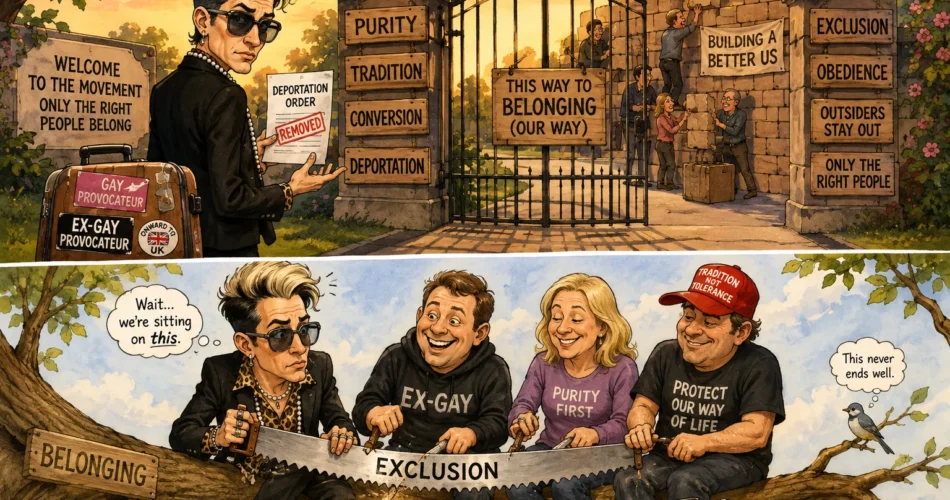
I have always found Milo Yiannopoulos difficult to categorize: He’s an openly gay British man who became a minor celebrity in a right-wing American political movement that opposes homosexuality. A man who celebrated interracial relationships while associating with white nationalists such as Nick Fuentes. A man with Jewish ancestry who cultivated antisemites. Then, in 2021, the flamboyantly gay provocateur announced that he was now “ex-gay.” And in early 2026, he at least momentarily declared himself “ex-ex-gay” without explanation or apology for his hypocrisies and his ongoing grift.

And now the anti-immigration activist has a new claim to fame: mass-deportation advocate who is himself involuntarily deported.
These contrasts look like ideological chaos. But Milo becomes more predictable if we look at what remains constant while his identities and allegiances mutate.
Transgression comes first. Milo built his reputation at Breitbart by violating the expectations of whoever he was addressing. Being extravagantly gay and conservative once worked perfectly: It irritated liberals who expected gay people to be liberal and tolerant, and triggered traditionalists who expected conservatives to behave with restraint and self-repression.
It also gave Milo a precarious home in the United States. In 2017, he was living and working here under an O-1 visa for people of “extraordinary ability”. But that year, Milo’s talent for transgression finally exceeded Breitbart’s tolerance for it. Earlier comments resurfaced in which he appeared to condone sexual relationships between teenage boys and adult men. Milo, who has said he was himself sexually abused as a teenager, disputed that characterization and apologized for the way he had discussed the subject. But the fallout cost him a CPAC appearance, a book contract and ultimately his job at Breitbart.
Even then, Milo had another potential source of belonging. Later that year, he married his longtime American boyfriend in Hawaii.
Two years later, according to the Department of Homeland Security, Yiannopoulos legally entered the United States through New York on May 14, 2019. Authorities have not publicly explained what immigration status he used for that admission. Whatever happened in between, his marriage apparently did not result in permanent residency.
By 2021, meanwhile, “gay conservative provocateur” was no longer especially novel. Milo adopted a more transgressive identity: Catholic traditionalist embracing supposed sexual orientation change.
He promoted abstinence from gay sex, said his husband had been “demoted” to housemate, embraced traditionalist Catholicism and talked about rehabilitating conversion therapy. Whether this represented religious conversion, publicity-driven reinvention, or some combination is ultimately impossible for us to know.
But we don’t need to know Milo’s private motives to see the continuity.
Milo gravitates toward people willing to violate taboos. He attacks establishments on the left and right that reject him. He forms alliances with people whose ideologies exclude him. And he turns the resulting contradictions into part of the performance.
His identity changes, but his method doesn’t. This time, however, the reinvention may have carried an unusually concrete price. Milo eventually claimed to be divorcing his husband, closing at least a potential path toward permanent legal residency through marriage. We don’t know whether he ever sought a marriage-based green card, and remaining married would not automatically have entitled him to one. But in renouncing one form of belonging, Milo ultimately found himself without another.
Consider also his role in the extraordinary 2022 dinner between Donald Trump, Ye and white nationalist Nick Fuentes. Yiannopoulos helped connect Ye with Fuentes and later said he knowingly helped create the circumstances that put Fuentes at Trump’s table, partly to damage Trump politically. In effect, he helped elevate one extremist whose politics leave little room for someone like Milo while using that extremist’s toxicity as a weapon against a leading figure on the right whom Milo had previously celebrated.
Milo’s identity as a former-former-homosexual fits the same pattern.
The earlier Milo challenged anti-gay conservatives simply by entering their movement as an unapologetically gay man. The later Milo challenged gay people by entering traditionalist Catholicism as an unapologetically ex-gay man, and then stabbing himself in the back with an ex-ex-gay tweet. In all three cases, the contradictions brought wanted attention and desired political conflict.
That doesn’t mean Milo’s religious beliefs are necessarily insincere. Sincerity and performance aren’t mutually exclusive.
The durable characteristics in Milo’s journey appear to be boundary-crossing, attraction to radical outsiders, being ostracized, theatrical self-reinvention, resentment toward institutions that reject him and, finally, a willingness to use his own identity as a divisive political weapon rather than as a means of finding common ground.
Milo’s latest predicament illustrates the pattern almost too neatly.
Despite lacking permanent legal status in the United States, Yiannopoulos became an enthusiastic advocate of aggressive immigration enforcement. Last year he called for “zero immigration” for 20 years. He went considerably further elsewhere, proposing ICE checkpoints at supermarkets, gas stations and other public places, with immediate deportation for people unable to prove that they were legally present.
The machinery he cheered on eventually came for him.
ICE arrested Yiannopoulos Thursday at the New Orleans airport. DHS says he had overstayed the authorization under which he legally entered the country in 2019 and failed to appear for an immigration hearing. An immigration judge issued a final removal order July 22.
On August 28, 2026, ICE deported Milo Yiannopoulos to the United Kingdom.
So, once again, Milo had embraced an exclusionary political system whose rules would eventually exclude Milo himself.
There is a lesson here for the conversion therapy and sexual orientation change movements as well. Its history includes prominent leaders who built boundaries around homosexuality only to discover that those boundaries could not comfortably contain their own lives:
- John Paulk, once perhaps the movement’s most famous “ex-gay” success story and chairman of Exodus International, was discovered in a Washington gay bar in 2000. He eventually acknowledged that his sexual orientation had never changed, repudiated reparative therapy and apologized for the harm he had helped cause. (Washington Post)
- John Smid ran Love in Action, one of the most notorious residential ex-gay ministries, including a controversial program for gay teenagers. After leaving, Smid apologized for harming participants, acknowledged that he remained gay, and said he had never encountered a man who actually changed from homosexual to heterosexual. He later married a man. (Wikipedia)
- McKrae Game founded Hope for Wholeness and spent about 20 years promoting conversion from homosexuality before the organization fired him in 2017. Two years later, Game came out as gay, called conversion therapy harmful, and apologized to people hurt by the movement he had built. (TIME)
The details differ greatly from Milo’s story, and unlike these three men, Milo has not repudiated the movement he promoted. But the recurring problem is familiar: Build belonging around the exclusion of an unwanted part of yourself, and eventually you may discover that the gate doesn’t distinguish very well between the impurity you were trying to cast out and the person doing the casting.
The gate Milo helped cheer shut finally closed with Milo on the outside. And that may be the most predictable thing about his journey from gay right-winger to self-shaming ex-gay to disingenuous and not-yet-accountable ex-ex-gay:
The labels change. The provocateur—forever wooing people who jilt them, then playing the jilters against each other—remains the same.