
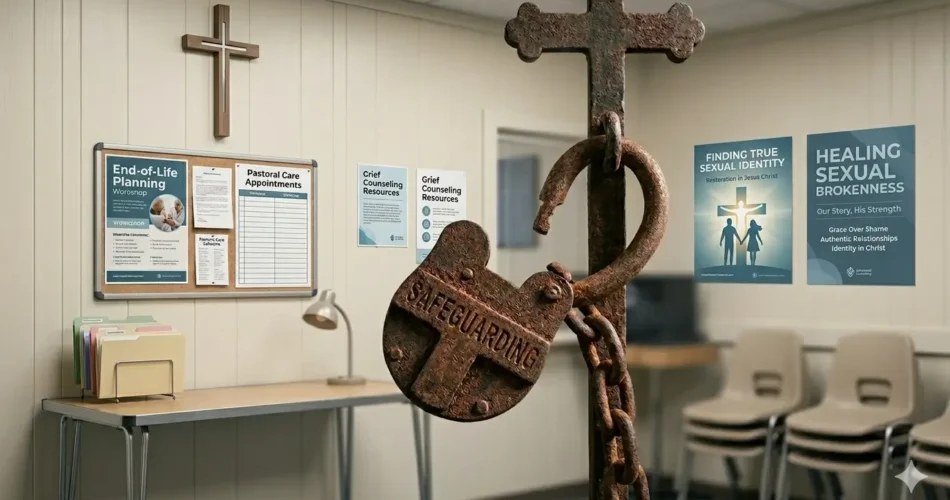
Where Are the Safeguards at Sexual Orientation Change Ministries?
Organizations such as the Restored Hope Network, Changed Movement, Brothers on a Road Less Traveled (also known as Brothers Road), and Portland Fellowship promise transformation to people in deep emotional distress over their sexual orientation or gender identity. They work with vulnerable adults, sometimes minors, and sometimes survivors of prior sexual abuse. Yet a review of their public-facing materials reveals a striking absence: None of these organizations appear to publish formal, enforceable policies for preventing sexual misconduct and abuse within their programs.
I find no publicly accessible background check requirements for leaders, no mandatory reporter protocols, no independent complaint mechanisms, no codes of conduct governing the relationship between leaders and participants, and no enforcement measures.
This matters, I think, and the need is urgent.
Operating Outside Professional Oversight
These organizations fall outside any state regulation, licensing, or oversight. Portland Fellowship, for example, explicitly states it is “not a mental-health agency” and does not practice what is commonly referred to as reparative or conversion therapy. The Restored Hope Network describes its member ministries as being led by a mix of “pastors, counselors, well-equipped lay persons” — few of whom are subject to professional oversight.
The programs involve intensive emotional work, group vulnerability exercises, and significant power imbalances between leaders and participants. In any licensed therapeutic setting, these conditions would trigger robust structural protections: informed consent procedures, dual-relationship prohibitions, independent review boards, and mandated reporting requirements. Those measures are what make licensed professional therapy relatively safe from sexual abuse. In U.S. ministry settings, however, such protections rarely or barely exist.
A Pattern of Harm
The absence of safeguards is not hypothetical. The broader sexual orientation change ministry space has a documented history of abuse:
- Alan Chambers, the former president of Exodus International — the predecessor umbrella organization to the Restored Hope Network — was arrested in May 2026 after allegedly exchanging sexual messages with someone he believed to be a 14-year-old boy, who turned out to be an undercover detective. He was charged with solicitation of a minor, transmitting harmful material to a minor, and unlawful use of a two-way communication device.
- Living Hope Ministries, as documented in the film “Pray Away,” pressured a young Julie Rodgers to publicly disclose details of a prior sexual assault in her testimony to make it more compelling for audiences. That’s a clear example of institutional exploitation of a survivor’s trauma.
- Before People Can Change changed its name to Brothers Road, its Journey Into Manhood program faced a consumer fraud complaint to the Federal Trade Commission in 2016.
- Desert Stream/Living Waters Ministries, a member of the Restored Hope Network, acknowledged through its own founder, Andrew Comiskey, that a longstanding staff member sexually abused at least one teenager who had sought help from the ministry. In 2010, founder Andrew Comiskey admitted in a blog post that a family had sued Desert Stream over the sexual abuse of a teenager undergoing therapy to change his sexual orientation. The case was settled out of court.
- In 2011, ex-gay activist Scott Lively was caught employing a convicted child sexual abuser to run his local youth drop-in center, the Holy Grounds Coffee House, in Springfield, Massachusetts.
Policing Participants, Not Leaders
One of the more professionally run ministries in this space is Portland Fellowship. A closer look at Portland Fellowship’s residential program, the Upper Room Community, illustrates where these organizations place their enforcement energy… and where they don’t. The program’s published requirements page states that participants “are expected to live within moral guidelines implicitly and explicitly found in scripture: no sexual misconduct, no drunkenness, no illegal or recreational drug use, no gossip or slander, etc.” and that “violations of these moral standards will be dealt with immediately, and could result in expulsion from the Upper Room Community and eviction from the house.”
In other words, Portland Fellowship has a detailed behavioral code. But it applies to participants, not to ministry leaders. There is no corresponding published code of conduct governing leader behavior, no published boundary policies for the staff-participant relationship, no independent reporting mechanism for participants who experience misconduct by those in authority over them. The surveillance runs in one direction: the organization monitors and disciplines the people in its care, while publishing no comparable framework for holding itself accountable. For a nine-month residential program costing $800 per month, where participants are expected to attend multiple weekly sessions and scheduled mentoring meetings, this lack of accountability is a serious red flag.
Rebranding the Practice: Change Efforts by Another Name
The accountability gap is compounded by a pattern of strategic rebranding. When Oregon’s HB 2307 sought to ban licensed therapists from practicing sexual orientation or gender identity change efforts (SOGICE) on minors, Portland Fellowship published an April 2015 newsletter explicitly distancing itself from the legislation. The newsletter argued that the ministry does not practice “reparative therapy” or “conversion therapy” because its staff serve “in a layman capacity, not as professional therapists,” and because its stated goal is “wholeness and healing through Christ” rather than “sexual reorientation.”
Yet in the same document, the ministry described homosexuality as “a relational issue” with “relational” solutions, outlined a methodology of “discipleship, surrender, prayer, and obedience” aimed at “moving us toward emotional and sexual wholeness,” and opposed the proposed ban because it would prevent minors from exploring “resolutions through therapy.” The substance of the work — programs designed to move people away from same-sex attraction and toward a heterosexual norm — remains functionally identical to what professional and medical bodies define as SOGICE. By framing it as ministry rather than therapy, organizations such as Portland Fellowship, the Changed Movement, and other Restored Hope Network affiliates effectively position themselves beyond the reach of the consumer protection and professional conduct laws that are designed to prevent harm, even while they continue to deliver the same interventions under a different label.
The System Is the Problem
Several institutional traits compound the risk in SOGICE settings. Participants arrive in conditions of acute emotional vulnerability, often experiencing shame, family pressure, and religious distress. Then SOGICE programs encourage deep personal disclosure in group settings. Leaders hold enormous influence over participants’ self-understanding and life decisions. And many participants are survivors of prior abuse, a population that licensed professional standards recognize as requiring heightened safeguards.
Brothers Road, for instance, runs a dedicated program for male survivors of childhood sexual abuse, while Portland Fellowship describes its participants as people “wounded by past hurts.” These are exactly the populations for whom formal, enforceable protections are most critical, and yet they are conspicuously absent from these ministries.
What Accountability Looks Like
Mainstream religious organizations have increasingly adopted formal safeguarding frameworks in the wake of abuse scandals: criminal background checks for all leaders and volunteers, mandatory safeguarding training, two-adult rules for interactions with minors, clear reporting protocols, and independent review of complaints. These are baseline expectations, not aspirational goals.
The organizations that we name here fall short of even these baseline standards in their public disclosures. General statements opposing forced treatment, such as Brothers Road’s position that it opposes any change effort “forced on anyone against their will,” are not substitutes for enforceable policies with complaint procedures, third-party oversight, and real consequences.
The Bottom Line
People seeking help from these organizations deserve to know: Who screens the leaders? What happens when boundaries are violated? Where do complaints go? Who investigates? What are the consequences?
Until these organizations can answer those questions publicly and transparently, the people they claim to serve remain at elevated risk. And the pattern of harm documented across this movement is likely to continue.